Andy Warhol American , 1928-1987
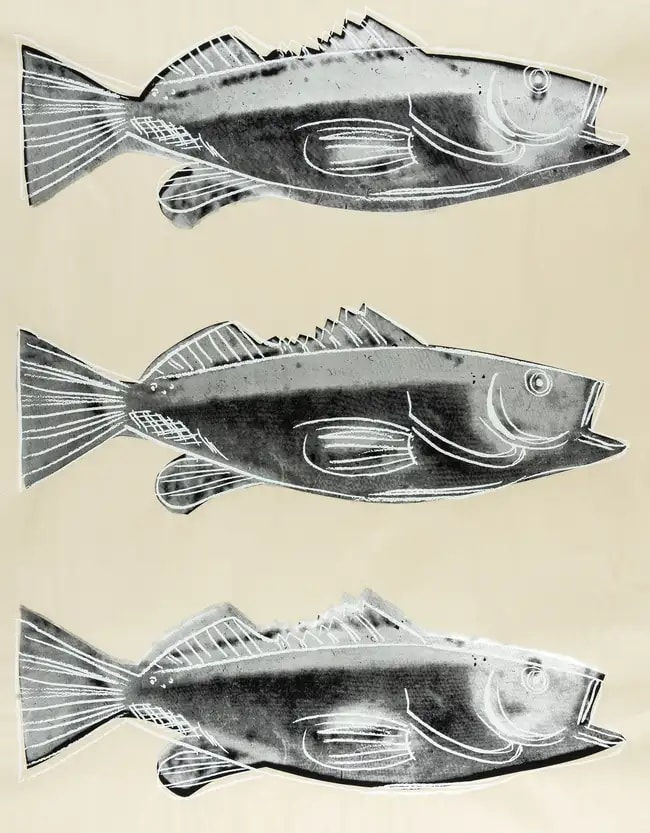
Fish , 1983
Screenprint in colours
106 x 76.2 x 0.1 cm
Stamped by artist's estate, Estate of Andy Warhol and the Andy Warhol Foundation ink stamps verso.
Copyright The Artist
In 1983, Andy Warhol was invited by his longtime Swiss dealer Bruno Bischofberger to create something just for children at his eponymous gallery in Zurich. The result was a magical...
In 1983, Andy Warhol was invited by his longtime Swiss dealer Bruno Bischofberger to create something just for children at his eponymous gallery in Zurich.
The result was a magical exhibition ‘Paintings for Children’, where small paintings were hung at children’s eye level and Warhol created a new wallpaper featuring shimmering silver fish turning the gallery space into an aquarium. The wallpaper was later used as inspiration for a rare editioned artwork, three fish per sheet, directly inspired by the exhibition.
The work is a superlative example of Warhol’s later practice in which he enjoyed dissolving the boundaries between fine art, decoration and exhibition design. He has taken an instantly recognisable, ordinary subject and placed it firmly within Pop Art’s fascination with everyday imagery and mass culture.
The result was a magical exhibition ‘Paintings for Children’, where small paintings were hung at children’s eye level and Warhol created a new wallpaper featuring shimmering silver fish turning the gallery space into an aquarium. The wallpaper was later used as inspiration for a rare editioned artwork, three fish per sheet, directly inspired by the exhibition.
The work is a superlative example of Warhol’s later practice in which he enjoyed dissolving the boundaries between fine art, decoration and exhibition design. He has taken an instantly recognisable, ordinary subject and placed it firmly within Pop Art’s fascination with everyday imagery and mass culture.
Join Our Mailing List
* denotes required fields
We will process the personal data you have supplied in accordance with our privacy policy (available on request). You can unsubscribe or change your preferences at any time by clicking the link in our emails.