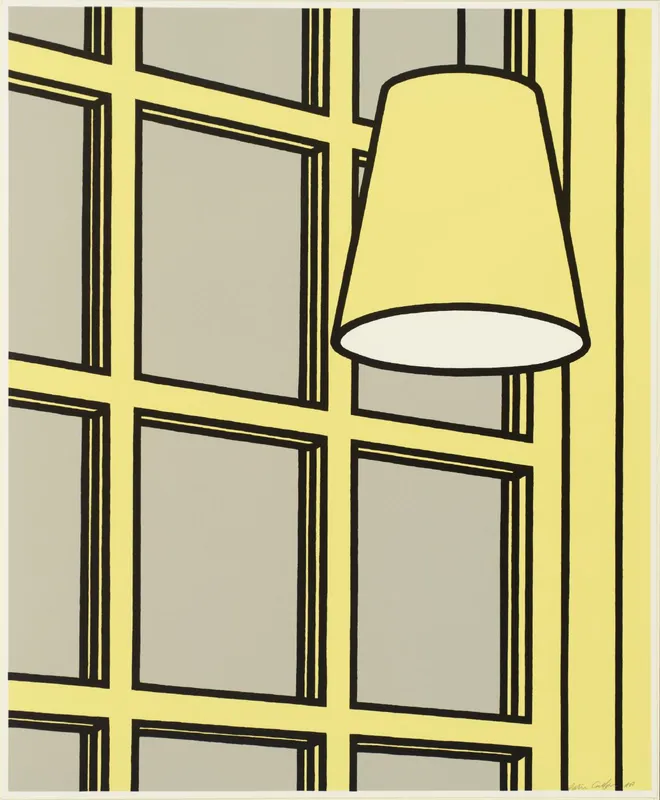
Patrick Caulfield was one of the most distinctive voices in Post-War British art, known for his pared-back compositions and striking use of colour.
Born in London, Caulfield studied at Chelsea School of Art before continuing his training at the Royal College of Art, where he was a contemporary of artists such as David Hockney and Allen Jones. While often associated with Pop Art, his influences were rooted as much in European modernism, particularly the work of Georges Braque, Juan Gris and Fernand Léger, as in the visual language of contemporary culture.
Caulfield’s work is immediately recognisable for its crisp black outlines, flattened perspective and bold, saturated colour. His compositions often depict everyday interiors and commonplace objects, lamps, tables, drinks, domestic scenes, reduced to their essential forms. Beneath this apparent simplicity lies a carefully considered tension between representation and abstraction, giving his work a quiet but enduring sophistication.
Printmaking became a central part of Caulfield’s practice from the mid-1960s, following his introduction to screenprinting by Richard Hamilton and master printer Chris Prater. The clarity and precision of the medium proved perfectly suited to his visual language, resulting in a body of graphic work that remains among the most refined and consistent of his generation.
During his lifetime, Caulfield’s work was the subject of major exhibitions at leading institutions, including the Serpentine Gallery, Hayward Gallery and Tate. His reputation has only strengthened since his death, with further retrospectives and continued institutional recognition. Tate holds a complete collection of his prints, (over 100 works produced between 1964 and 1999), alongside a significant group of paintings.
Elected a Royal Academician in 1993 and awarded a CBE in 1996, Caulfield was also nominated for the Turner Prize in 1987. He died in London in 2005, leaving behind a body of work that continues to define a uniquely British approach to modern painting and printmaking at once restrained, elegant and quietly radical.