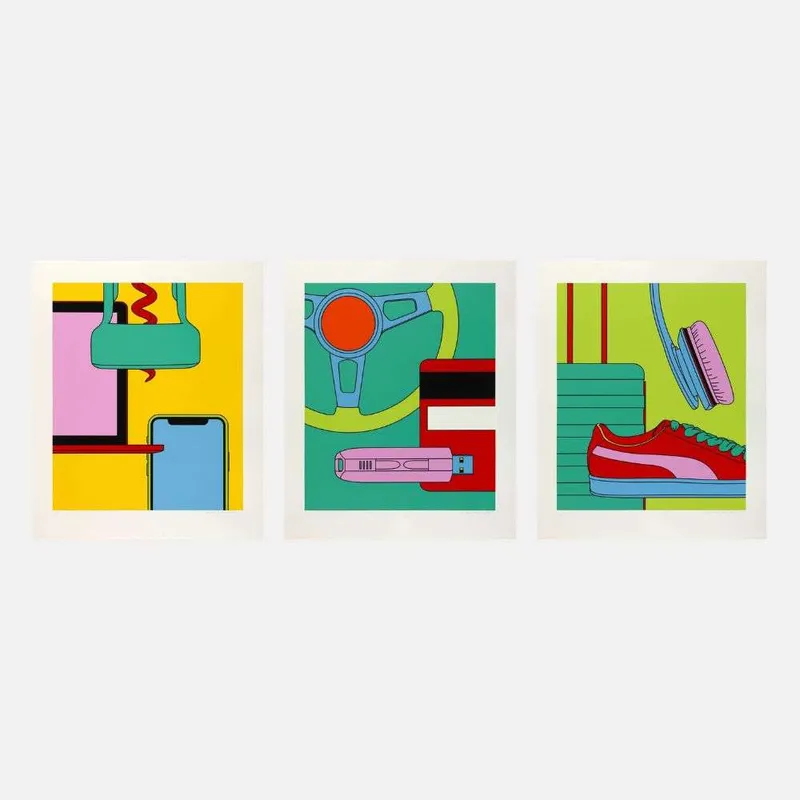
Sir Michael Craig-Martin CBE RA is one of the most influential figures in contemporary British art, recognised both for his pioneering role in conceptual art and for his lasting impact on generations of artists.
Born in Dublin, Craig-Martin was raised and educated in the United States, where he studied Fine Art at Yale University School of Art and Architecture. Following the completion of his studies in 1966, he moved to London, where he has lived and worked ever since, becoming a central figure in the evolution of contemporary art in Britain.
Craig-Martin first came to prominence in the late 1960s, with early works that brought together everyday objects and materials to question the nature of art and representation. His seminal piece, An Oak Tree (1973), remains one of the most important works of conceptual art. It is an enduring statement that challenged perceptions of authorship, meaning and the role of the artist.
Over time, his practice has developed into the bold, graphic visual language for which he is now widely known. Working across painting, drawing, printmaking and digital media, Craig-Martin depicts commonplace objects; telephones, glasses, lightbulbs and shoes rendered in precise line and vivid, saturated colour. These works elevate the familiar, creating images that are at once immediate and conceptually rigorous, bridging the space between Pop Art and conceptualism.
Craig-Martin held his first solo exhibition at the Rowan Gallery, London, in 1969, and has since exhibited extensively both in the UK and internationally. Major retrospectives of his work have been held at the Whitechapel Gallery (1989), the Irish Museum of Modern Art (2006), and the Serpentine Gallery (2015). His work has also featured in significant group exhibitions, including The New Art at the Hayward Gallery (1972), and he represented Britain at the São Paulo Biennial in 1998.
Alongside his artistic practice, Craig-Martin has had a profound influence as a teacher. His tenure at Goldsmiths College in particular helped shape a generation of artists who would come to define the British art scene of the 1990s, including Damien Hirst, Gary Hume and Sarah Lucas. His role in fostering these artists places him at the heart of the story of contemporary British art.
Craig-Martin has also contributed widely as a curator and writer. He curated exhibitions such as Drawing the Line (1995) and the Royal Academy Summer Exhibition (2015), and is the author of On Being an Artist (2015), a widely regarded reflection on artistic practice and creativity.
His work is held in major international collections, including the Tate, Museum of Modern Art, Centre Pompidou and the Victoria and Albert Museum, reflecting the global significance of his practice.
In recognition of his contribution to the arts, Craig-Martin was appointed CBE in 2001 and knighted in 2016. He has also served as a Trustee of Tate and the Art Fund, further contributing to the wider cultural landscape in Britain.
Today, Sir Michael Craig-Martin’s work remains instantly recognisable, defined by its clarity, precision and bold use of colour, securing his place as a pivotal figure in the development of contemporary art.